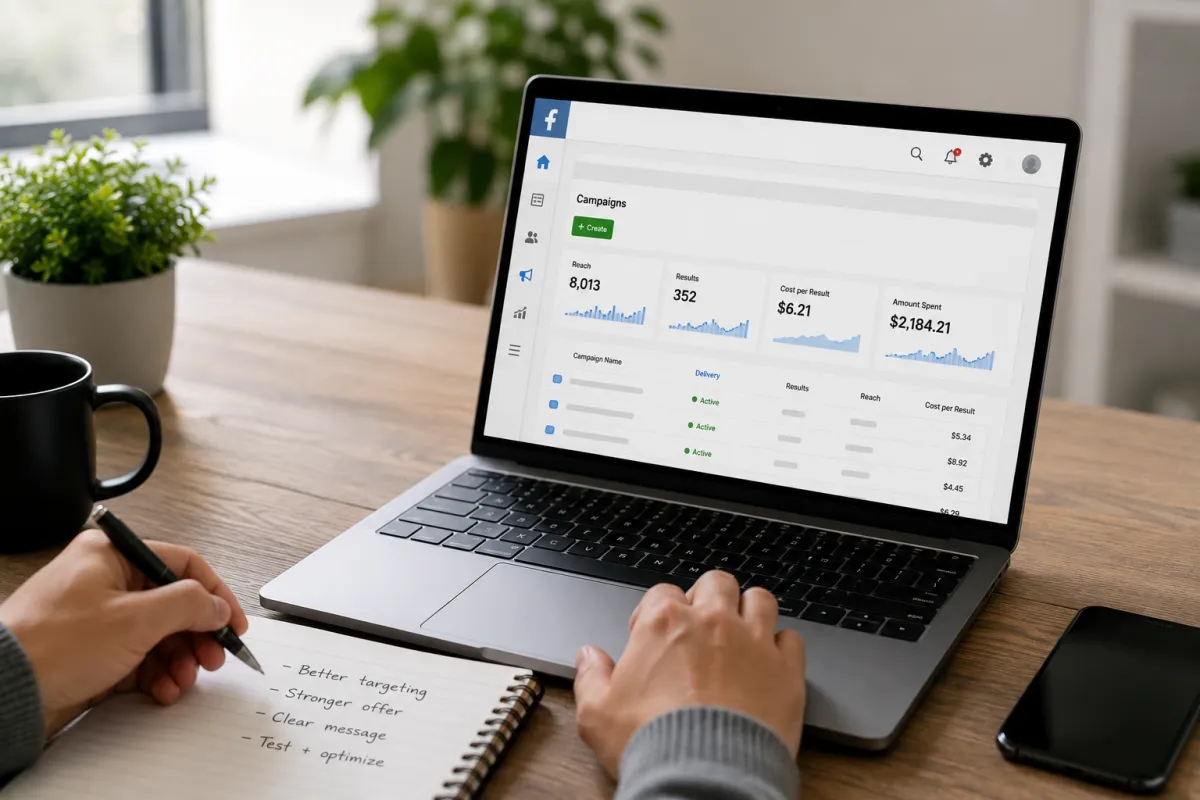
10 Facebook Ad Mistakes That Waste Your Marketing Budget
Common Facebook ad mistakes include targeting audiences too broadly, using weak creative, sending traffic to poor landing pages, changing campaigns too quickly, ignoring mobile users, and optimizing for the wrong objective. Better results usually come from strong offers, clear messaging, reliable tracking, thoughtful testing, and giving Meta enough useful conversion data to optimize campaigns.
Your Facebook Ads Might Not Be the Problem
You launch a Facebook campaign.
The ads look good. The targeting seems reasonable. The budget starts spending.
Then you wait.
A few likes arrive. Maybe some clicks.
But the phone is not ringing, the leads are disappointing, and your cost per result keeps climbing.
Naturally, the first thought is:
"Facebook Ads don't work for my business."
Sometimes that is true. Facebook is not the perfect advertising channel for every offer.
But often, the platform itself is not the biggest problem.
It is what happens between the campaign setup and the customer conversion.
Before increasing your budget or abandoning Facebook advertising altogether, check whether one of these ten mistakes is quietly working against you.
1. Trying to Advertise to Everyone
It sounds logical.
The more people who see your ad, the more potential customers you reach.
Right?
Not necessarily.
A local roofing company does not need to reach every Facebook user in the state. A luxury remodeling company probably does not need an audience built around people looking exclusively for the cheapest possible contractor.
Your audience should reflect the people most likely to need, want, and afford what you offer.
At the same time, avoid squeezing targeting so tightly that Meta has almost no room to optimize.
The goal is not necessarily the smallest audience.
It is the right audience.
2. Starting With a Boring Ad
Facebook is not a newspaper.
People are not opening the app because they are excited to see your advertisement.
They are looking at:
Family photos
Reels
News
Friends
Groups
Entertainment
Your ad interrupts that experience.
That means the creative needs to earn attention.
Instead of another generic stock photo with:
WE PROVIDE QUALITY SERVICE!
Try showing something real.
A completed project.
Your team at work.
A dramatic before-and-after.
A customer problem people immediately recognize.
Your ad does not have to look like a Hollywood production.
In fact, authentic creativity often feels much more natural in a social feed.
3. Talking About Yourself Too Much
Businesses love writing ads like this:
"We have 25 years of experience and offer industry-leading solutions with outstanding customer service."
Those things can build credibility.
But your customer is probably thinking:
"Okay, but what can you do for me?"
Shift the perspective.
Instead of:
We offer professional basement waterproofing.
Try:
Tired of worrying every time heavy rain appears in the forecast? Find out what's causing water to enter your basement and what can be done about it.
Same service.
Completely different conversation.
Great advertising makes the customer feel understood before asking them to buy.
4. Choosing the Wrong Campaign Objective
This is one of the easiest ways to get impressive numbers that produce disappointing business results.
If you tell Meta you want traffic, the system will try to find people likely to click.
That does not necessarily mean those people are likely to become customers.
If your real goal is leads, bookings, or purchases, your campaign structure should reflect that goal whenever appropriate.
Meta's own Facebook advertising objectives guidance explains how campaign objectives help its system understand the business result advertisers want to achieve.
Do not optimize for the easiest metric.
Optimize toward the outcome that actually matters.
5. Sending Everyone to Your Homepage
Imagine clicking an ad that says:
"Get a Free Kitchen Remodeling Estimate."
You expect a page about kitchen remodeling.
Instead, you land on a homepage offering:
Kitchens
Bathrooms
Roofing
Decks
Flooring
Windows
General contracting
Now you have to hunt for the thing that brought you there.
Many people simply leave.
The landing page should continue the conversation started by the ad.
If the advertisement promotes one specific service, the destination should make that service immediately obvious.
Keep the message consistent from:
Ad → Click → Landing Page → Call to Action
Every unnecessary detour gives someone another opportunity to disappear.
6. Asking for Too Much Too Soon
Picture meeting someone for the first time and immediately asking them to make a major purchase.
Awkward.
Yet businesses do this constantly with advertising.
A person who discovered your company ten seconds ago may not be ready to:
Schedule a major project
Request a complicated proposal
Spend thousands of dollars
Complete a 15-field form
Match your call to action to the customer's level of commitment.
Depending on the business, that might mean:
Get an Estimate
See Pricing Options
Book a Consultation
Check Availability
Learn More
The easier and more relevant the next step feels, the less friction you create.
7. Changing the Campaign Every Morning
Yesterday's results were bad.
Time to change the audience.
Today's results look expensive.
Change the creative.
Tomorrow morning?
New budget.
By Friday, the campaign has been modified so many times that you have no idea which variable actually mattered.
Advertising requires testing, but good testing requires patience.
Meta describes a learning phase during which its delivery system explores how best to deliver an ad set.
Constantly making significant changes can make performance harder to evaluate.
Give meaningful tests enough data before drawing conclusions.
One bad afternoon is not a trend.
8. Testing Five Things at Once
Testing is good.
Chaos is not.
Suppose you change the:
Headline
Image
Audience
Offer
Landing page
Then performance improves by 40%.
Fantastic.
But what caused the improvement?
You do not know.
Better testing isolates meaningful variables.
For example:
Test A: Same audience and offer, different image.
Then:
Test B: Winning image, different headline.
Then:
Test C: Winning creative, different offer.
You slowly learn what customers respond to.
That knowledge becomes valuable beyond one Facebook campaign.
9. Ignoring What Happens After the Lead Arrives
This mistake has nothing to do with Facebook.
And it can destroy an otherwise excellent campaign.
Imagine paying $40 for a qualified lead.
The customer submits a form at 10:15 a.m.
Nobody responds.
At 2:00 p.m., they contact your competitor.
The competitor calls within five minutes.
Who gets the business?
Marketing does not stop when the form is submitted.
You also need a lead-handling process.
That may include:
Fast phone follow-up
Email confirmation
Text notifications
CRM automation
Appointment scheduling
Lead qualification
Sometimes the fastest way to improve Facebook Ads ROI is not changing the ads at all.
It is improving what your business does with the leads you already generate.
10. Measuring Success With Likes Instead of Revenue
Your ad received:
327 likes.
Great.
Did anyone buy anything?
Social engagement can be useful, but businesses often become distracted by metrics that feel good without revealing whether advertising is profitable.
Pay closer attention to metrics such as:
Cost per lead
Qualified lead rate
Appointments booked
Cost per acquisition
Sales
Revenue
Return on ad spend
Meta's Business Tools information also explains tools such as the Meta Pixel that can help businesses understand actions people take after interacting with advertising.
The objective is not to win a popularity contest.
It is to generate profitable customer activity.
The Mistake That Is Not on the List: Expecting the Ad to Fix a Weak Offer
You can have brilliant targeting.
Beautiful and creative.
Perfect tracking.
A fast landing page.
And still struggle.
Why?
Because advertising amplifies the offer you already have.
If customers do not understand why they should choose you, spending more money simply shows that unclear offer to more people.
Before launching your next campaign, ask:
Why should someone respond today?
Maybe it is:
A free consultation
Transparent pricing
Same-week availability
A useful assessment
A compelling guarantee
A seasonal promotion
A genuinely differentiated service
The offer should give people a reason to move from interested to action.
A Better Facebook Ad Formula
If you want a simple starting point, think about four elements.
1. Hook
Get the right person's attention.
2. Problem
Show that you understand what they are experiencing.
3. Solution
Explain how your product or service helps.
4. Next Step
Tell them exactly what to do.
For example:
Still getting water in your basement after heavy rain?
The problem may be drainage or groundwater pressure, not simply the crack you can see. Our team can identify where the water is coming from and recommend the right solution.
Schedule an inspection.
Simple.
Relevant.
Human.
No marketing gymnastics required.
Before You Spend Another $100, Check These 7 Things
Ask yourself:
✓ Is the offer genuinely attractive?
✓ Does the creative stop the right person's scroll?
✓ Does the copy focus on the customer?
✓ Are we optimizing for the right result?
✓ Does the landing page match the ad?
✓ Is conversion tracking working?
✓ Can our team respond quickly when leads arrive?
If the answer to several of these is no, increasing the budget probably will not solve the underlying problem.
Fix the system first.
Then scale what works.
Frequently Asked Questions
Why are my Facebook Ads getting clicks but no leads?
The problem may be a mismatch between the ad and landing page, weak offers, poor audience quality, slow pages, excessive form fields, or optimization toward clicks rather than meaningful conversions.
How much should a small business spend on Facebook Ads?
There is no universal budget. Your appropriate spend depends on customer value, conversion rates, market size, competition, campaign objective, and how much data is needed to evaluate performance.
Should I use photos or videos for Facebook Ads?
Both can work. Test formats that naturally demonstrate your offer. Real project photos, customer stories, short demonstrations, and straightforward videos can often feel more authentic than generic stock creative.
How long should I run a Facebook Ad before changing it?
There is no fixed number of days for every campaign. Avoid reacting to tiny amounts of data. Evaluate performance after the campaign has generated enough meaningful results to make a reasonable comparison.
Are Facebook Ads still worth it for small businesses?
They can be, particularly when a business has a clear offer, appropriate audience, good creative, accurate tracking, effective landing experience, and strong follow-up process. Profitability should ultimately determine whether the channel deserves continued investment.
Good Facebook Advertising Should Feel Less Like Advertising
People do not open Facebook hoping a local business will aggressively sell them something.
But they do notice useful, relevant messages.
They notice the contractor showing a problem they have been dealing with.
They notice the restaurant showing tonight's special.
They notice the company answering a question they were already thinking about.
That is the opportunity.
Stop trying to make your ads look more like ads.
Make them look and sound like something the right customer would genuinely want to stop and read.
Because the best Facebook campaign is not necessarily the one with the fanciest creative or the biggest budget.
It is the one that reaches the right person, makes them feel understood, and gives them a natural reason to take the next step.
