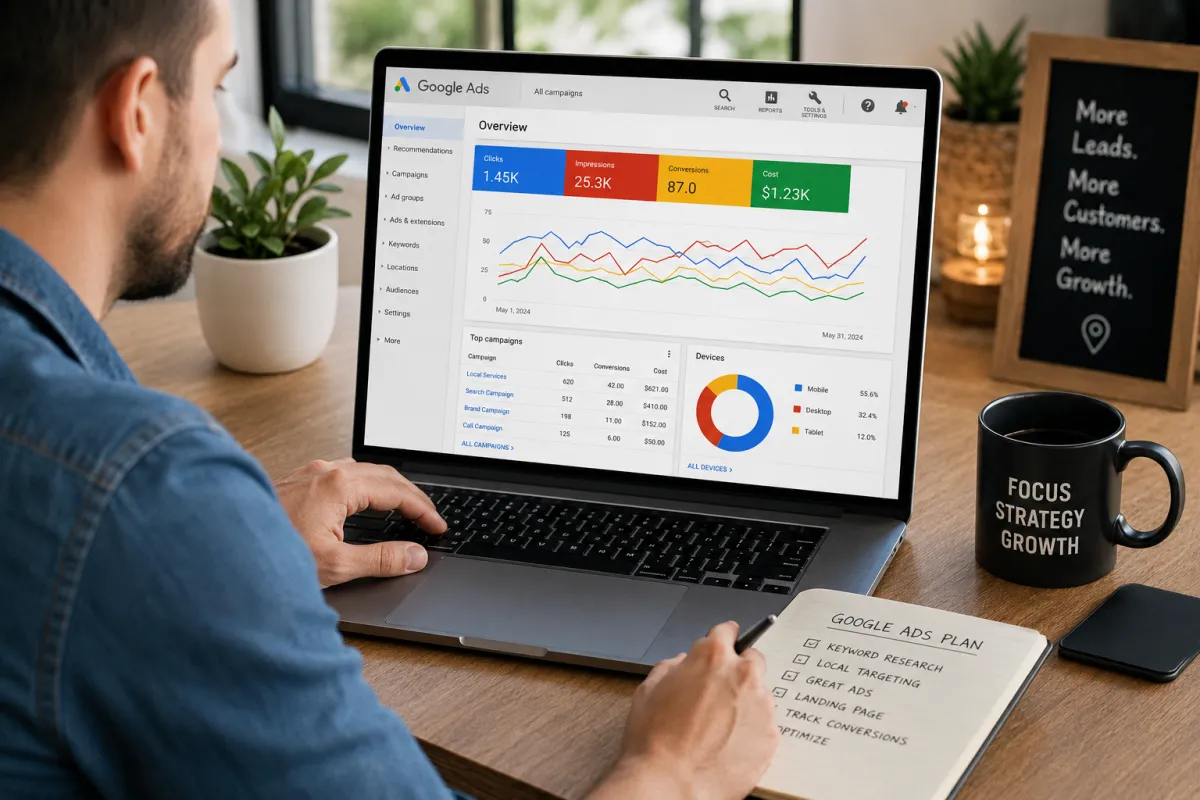
Google Ads for Local Businesses: Complete Setup Guide
Google Ads remains one of the fastest ways for local businesses to generate leads and customers. When properly configured, local Google Ads campaigns can target high-intent buyers who are actively searching for products and services nearby. This guide walks through the key steps to building a successful local Google Ads campaign.
Why Google Ads Still Works for Local Businesses
When someone searches:
"roof repair near me"
"foundation repair contractor"
"asphalt paving company"
"family chiropractor nearby"
they often need help immediately.
Unlike social media advertising, Google Ads captures people who are actively looking for solutions.
According to Google Ads Help, search campaigns allow businesses to appear directly in front of users searching for specific products and services.
For local businesses, this means reaching potential customers at the exact moment they are ready to take action.
Step 1: Start With a Clear Goal
Before creating a campaign, define what success looks like.
Common goals include:
Phone calls
Form submissions
Appointment bookings
Store visits
Quote requests
One of the biggest mistakes local businesses make is trying to optimize for everything at once.
The best campaigns focus on a single primary conversion objective.
For businesses focused on lead generation, your ads should connect directly to a strong appointment booking process that turns clicks into conversations.
Step 2: Set Up Google Business Profile First
Before spending money on ads, optimize your Google Business Profile.
Include:
Accurate business information
Service areas
Photos
Business hours
Customer reviews
According to Google's Local Business Documentation, local business information plays an important role in helping users find relevant nearby services.
A complete profile supports both paid and organic visibility.
Step 3: Choose the Right Keywords
Keyword selection is the foundation of every Google Ads campaign.
Focus on:
High-Intent Keywords
Examples:
foundation repair near me
asphalt contractor Boston
custom home builder Missouri
chiropractor near me
These searches often indicate buying intent.
Avoid broad informational keywords that generate traffic but not customers.
The goal is quality leads, not simply more clicks.
For local businesses looking to maximize ROI, understanding keyword intent is often part of a larger digital marketing strategy.
Step 4: Use Geographic Targeting
One advantage of Google Ads is precise local targeting.
You can target:
Cities
Counties
Zip codes
Service areas
Radius targeting
For example, a contractor serving Springfield, Missouri doesn't need to pay for clicks coming from another state.
Google recommends using location targeting to focus budgets on the areas where customers are most likely to convert.
This helps improve efficiency and reduce wasted ad spend.
Step 5: Write Ads That Match Search Intent
The best ads directly reflect what users are searching for.
A simple structure works well:
Headline
Include the keyword.
Example:
"Foundation Repair Near Missouri"
Benefit
Explain the value.
Example:
"Protect Your Home With Local Foundation Experts"
Call-to-Action
Tell users what to do next.
Example:
"Schedule Your Free Inspection Today"
Strong messaging improves click-through rates and conversion rates.
Step 6: Create a Landing Page That Converts
Many businesses send ad traffic to their homepage.
This is often a mistake.
Dedicated landing pages should include:
Clear headline
Service information
Customer reviews
Trust signals
Strong call-to-action
Mobile-friendly design
According to Google's Helpful Content Guidelines, useful and relevant content improves user experience and engagement.
Every ad should lead users to the most relevant page possible.
For businesses struggling with lead generation, improving conversion-focused landing pages often produces immediate improvements.
Step 7: Install Conversion Tracking
Without tracking, you're guessing.
Google Ads conversion tracking helps measure:
Phone calls
Form submissions
Appointment requests
Sales
Tracking allows businesses to identify:
Which keywords generate leads
Which ads perform best
Which campaigns deserve more budget
Successful advertisers rely heavily on data rather than assumptions.
Step 8: Start Small and Optimize
Many businesses overspend early.
A better approach:
Start with a manageable budget
Collect data
Optimize campaigns
Scale gradually
Monitor:
Cost per click
Cost per lead
Conversion rate
Click-through rate
Small adjustments often produce major performance improvements.
For businesses seeking long-term growth, combining paid traffic with SEO and digital marketing services can create a more sustainable lead generation system.
Step 9: Use Call Extensions and Lead Forms
Local businesses often benefit from making contact easier.
Google Ads offers:
Call extensions
Lead form extensions
Location extensions
These features reduce friction and increase conversion opportunities.
The easier it is for users to contact you, the more likely they are to become customers.
Step 10: Continue Testing
No campaign is perfect from the start.
Ongoing testing should include:
Headlines
Descriptions
Keywords
Landing pages
Offers
Calls-to-action
Even small improvements can significantly increase ROI over time.
The businesses that consistently win with Google Ads are usually the businesses that consistently test and improve.
Common Google Ads Mistakes Local Businesses Make
Targeting Too Large of an Area
Focus on service areas.
Sending Traffic to the Homepage
Use dedicated landing pages.
Ignoring Conversion Tracking
Measure actual results.
Choosing Broad Keywords
Focus on buyer intent.
Stopping Optimization Too Soon
Successful campaigns improve over time.
Frequently Asked Questions
Are Google Ads worth it for local businesses?
Yes. Google Ads can generate highly qualified leads because users are actively searching for services.
How much should a local business spend on Google Ads?
Budgets vary by industry and competition, but many businesses start small and scale based on results.
How long does it take to see results?
Google Ads can begin generating traffic immediately, though optimization typically improves performance over time.
Should I use Google Ads and SEO together?
Yes. Paid advertising and organic search often complement each other and improve overall visibility.
Final Thoughts
Google Ads remains one of the most powerful tools available to local businesses.
When properly configured, campaigns can place your business directly in front of people actively searching for your services.
The key is combining:
Smart targeting
Strong keywords
Effective landing pages
Conversion tracking
Ongoing optimization
Businesses that approach Google Ads strategically often generate more leads, more calls, and better long-term marketing ROI.
If you're looking to improve your lead generation strategy, explore Top Choice Marketers and learn how integrated marketing systems can help turn ad clicks into paying customers.
