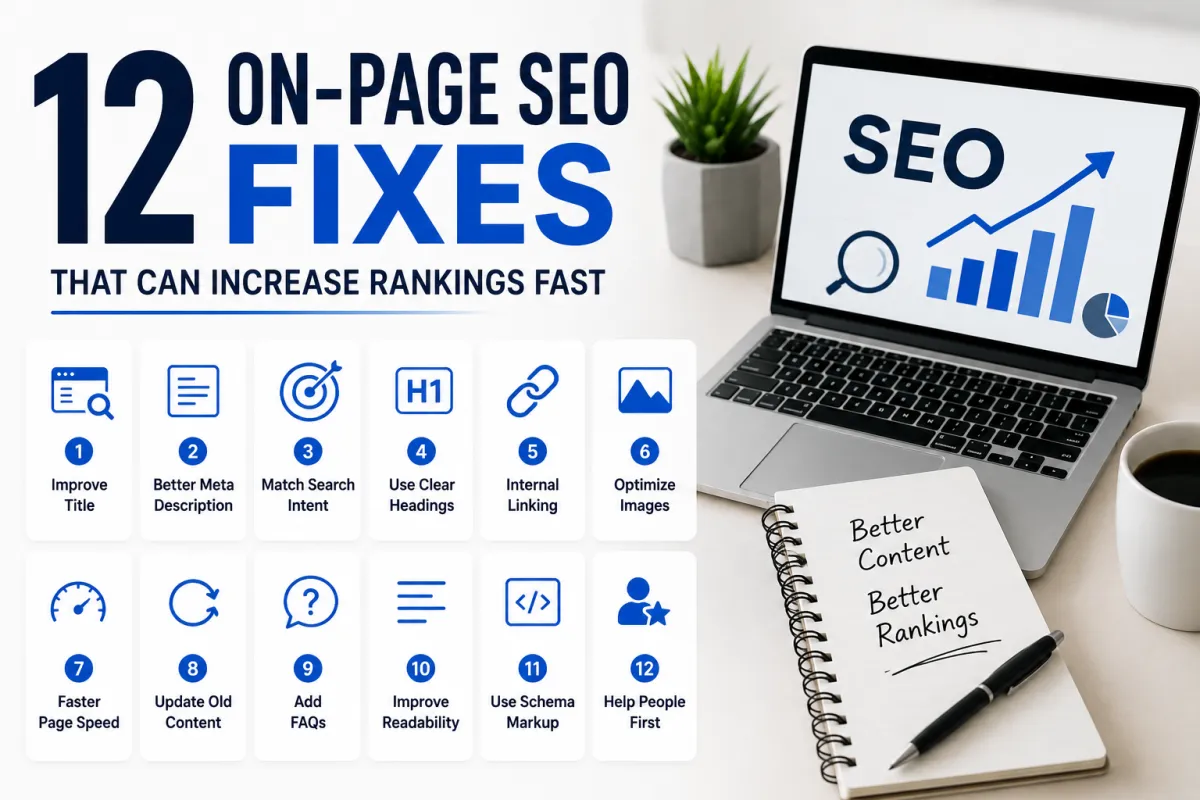
12 On-Page SEO Fixes That Can Improve Google Rankings Fast
On-page SEO remains one of the fastest ways to improve search rankings because it focuses on factors you control. Updating title tags, improving page speed, strengthening internal links, optimizing content structure, and matching search intent can help search engines better understand your website while creating a better experience for visitors.
Why On-Page SEO Still Matters in 2026
Every year, Google becomes better at understanding websites.
But one thing hasn't changed.
Search engines still rely on well-optimized pages to understand:
What your content is about
Who it helps
Why it deserves to rank
Many businesses invest thousands in advertising while overlooking simple website improvements that could increase organic visibility for years.
If you're building long-term online growth, a strong SEO strategy starts with your own website.
1. Rewrite Your Page Title
Your title tag is often the first thing users see in Google.
A great title should:
Include the primary keyword
Stay under 60 characters
Create curiosity
Match search intent
Google recommends writing descriptive titles that accurately represent page content.
Learn more in Google's SEO Starter Guide.
2. Improve Your Meta Description
While meta descriptions aren't a direct ranking factor, they significantly affect click-through rates.
Write descriptions that:
Explain the page clearly
Include the keyword naturally
Encourage users to click
Higher CTR often leads to stronger organic performance over time.
3. Match Search Intent
One of the biggest ranking mistakes is answering the wrong question.
Ask yourself:
Is the searcher looking to learn?
Compare?
Buy?
Hire someone?
Content that matches intent typically performs much better than keyword-focused content alone.
Businesses working on digital marketing strategies often see improvements simply by aligning content with user expectations.
4. Organize Content With Clear Headings
Google and users both appreciate well-structured pages.
Use:
One H1
Logical H2s
Supporting H3s
This improves readability while helping search engines understand page hierarchy.
5. Strengthen Internal Linking
Internal links distribute authority across your website.
They also help users discover additional resources.
Examples include linking to:
Related services
Helpful blog posts
Contact pages
Case studies
For example, businesses interested in generating more qualified leads can explore conversion-focused appointment systems as part of a complete SEO strategy.
6. Optimize Images
Images help users.
They also help SEO.
Every image should include:
Descriptive file names
Optimized file size
Relevant alt text
According to Google Image SEO documentation, optimized images improve accessibility and search visibility.
7. Improve Page Speed
Visitors won't wait for slow websites.
Google considers page experience an important part of delivering quality search results.
Simple improvements include:
Compressing images
Using modern formats like WebP
Reducing unnecessary scripts
Enabling browser caching
Even small speed improvements can reduce bounce rates.
8. Update Old Content
Fresh content often performs better than outdated pages.
Review existing articles and update:
Statistics
Examples
Internal links
FAQs
Images
Refreshing content is frequently faster than creating entirely new pages.
9. Add Helpful FAQs
FAQ sections increase topical relevance.
They also help answer related questions users commonly search for.
Well-written FAQs may improve eligibility for AI-generated search summaries and featured snippets.
10. Improve Readability
Most people scan before they read.
Make content easier to consume by using:
Short paragraphs
Bullet points
Clear headings
Simple language
Content that is easier to read often keeps visitors engaged longer.
11. Use Relevant Schema Markup
Schema helps search engines better understand your content.
Common examples include:
Article Schema
FAQ Schema
Local Business Schema
Service Schema
While schema doesn't guarantee higher rankings, it can improve how pages appear in search results.
The Schema.org documentation explains how structured data helps search engines interpret content.
12. Focus on Helping People First
Google continues rewarding helpful content.
Instead of writing for algorithms, create pages that genuinely solve problems.
Ask yourself:
Does this answer the user's question?
Is it easy to understand?
Would someone bookmark or share it?
Helpful content naturally earns more engagement, backlinks, and trust over time.
Businesses looking for sustainable growth often combine these improvements with professional SEO services to build long-term visibility.
Quick On-Page SEO Checklist
✅ Update title tag
✅ Improve meta description
✅ Optimize headings
✅ Add internal links
✅ Compress images
✅ Improve page speed
✅ Refresh outdated content
✅ Add FAQs
✅ Improve readability
✅ Implement schema
✅ Match search intent
✅ Focus on helpful content
Frequently Asked Questions
How long does on-page SEO take to work?
Some improvements can produce measurable ranking changes within a few weeks, while competitive keywords may take several months.
Is on-page SEO better than backlinks?
Both are important. On-page SEO provides the foundation, while backlinks strengthen authority.
Can I improve rankings without creating new content?
Yes. Updating and optimizing existing pages often produces excellent results.
What's the most important on-page SEO factor?
Matching search intent while providing genuinely helpful content remains one of the strongest ranking signals.
Final Thoughts
You don't always need hundreds of backlinks to improve your rankings.
Sometimes the fastest wins come from optimizing the pages you already have.
Better titles, cleaner structure, stronger internal links, improved speed, and user-focused content all contribute to stronger search performance.
If you're ready to improve your website's visibility and generate more qualified leads, explore Top Choice Marketers and discover how strategic SEO can help your business grow consistently.
