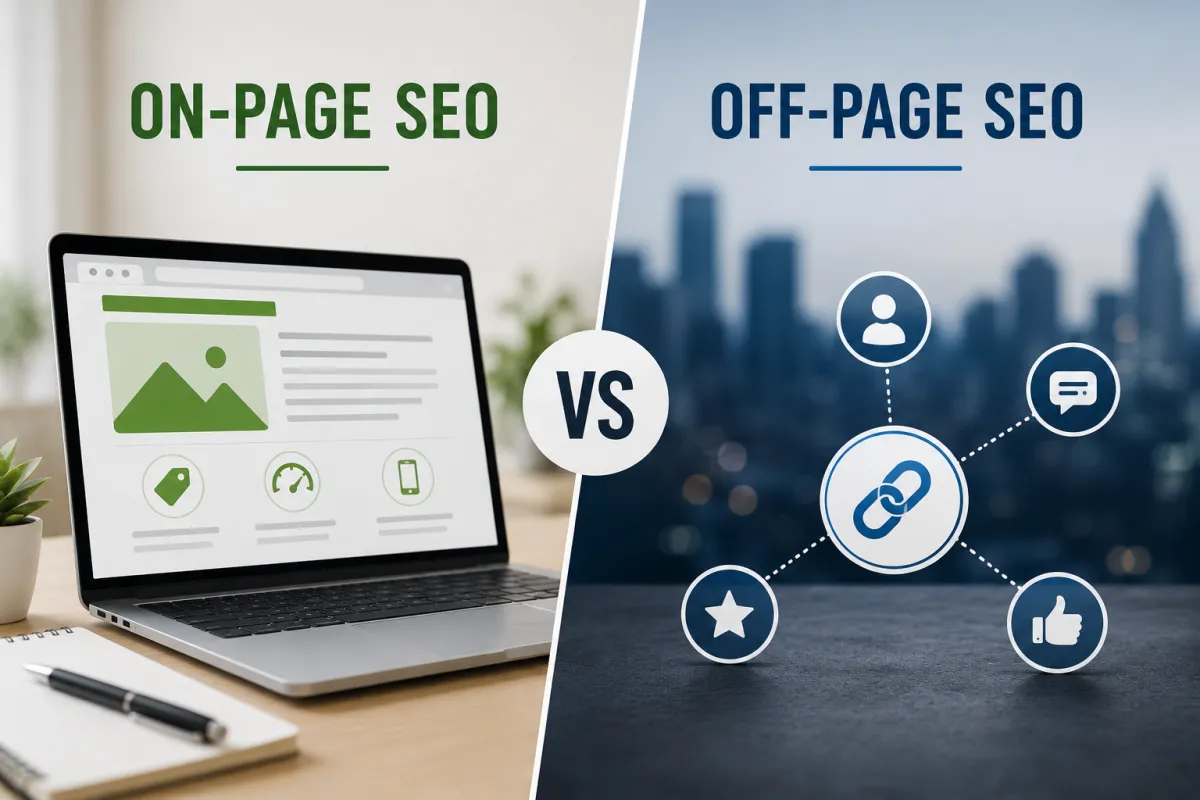
On-Page vs Off-Page SEO in 2026: What Impacts Rankings Most?
In 2026, both on-page and off-page SEO remain important, but search engines increasingly prioritize user experience, topical authority, trust signals, and content quality. Businesses that balance technical optimization with strong authority-building strategies tend to achieve the best long-term rankings.
Key Takeaways
On-page SEO controls how search engines understand your website
Off-page SEO builds trust and authority across the internet
Google increasingly rewards expertise and user experience
Strong rankings require both optimization and credibility
Topical authority matters more in 2026 than isolated keywords
The SEO Debate That Still Confuses Businesses
For years, marketers have argued about which matters more:
On-page SEO
orOff-page SEO
But in 2026, the real answer is more nuanced.
Search engines have evolved far beyond simple keyword placement or backlink counting.
Today, ranking well requires:
Technical clarity
Content quality
User trust
Brand authority
Real engagement signals
Businesses that focus on only one side of SEO often struggle to maintain consistent rankings long-term.
If your website traffic has plateaued, reviewing a full SEO growth strategy can help identify where visibility gaps are limiting performance.
What On-Page SEO Means in 2026
On-page SEO refers to everything directly controlled on your website.
This includes:
Content structure
Heading optimization
Internal linking
Page speed
Mobile experience
User engagement
Topical relevance
In 2026, search engines analyze content context far more deeply than before.
According to the Google Helpful Content Guidelines, content should demonstrate expertise, usefulness, and strong user value rather than simply targeting keywords.
This means websites must now optimize for:
User intent
Readability
Information depth
Experience signals not just keyword density.
Why On-Page SEO Still Matters More Than Most People Think
Without strong on-page optimization, search engines struggle to understand:
What the page is about
Which searches it should rank for
How useful the content actually is
Even powerful backlinks cannot fully compensate for weak content structure.
Strong on-page SEO improves:
Crawlability
Content relevance
Conversion experience
Search visibility consistency
For businesses targeting local visibility, our local SEO optimization services help strengthen technical and content performance together.
What Off-Page SEO Means Now
Off-page SEO focuses on authority signals outside your website.
This includes:
Backlinks
Brand mentions
Online reviews
Citations
Social engagement
Digital PR
Search engines use these signals to evaluate:
Credibility
Reputation
Trustworthiness
According to the Search Engine Journal link-building resources, high-quality backlinks remain one of Google’s strongest ranking signals because they act as external trust indicators.
But in 2026, quality matters dramatically more than quantity.
Why Low-Quality Backlinks Are Losing Value
Years ago, websites could rank using:
Massive backlink volume
Directory submissions
Spammy guest posts
That approach no longer works reliably.
Search engines now evaluate:
Source relevance
Contextual authority
Brand legitimacy
Link quality
One strong industry-relevant backlink now carries more value than dozens of low-quality links.
This shift has made authority-building slower but more sustainable.
The Real SEO Shift Happening in 2026
The biggest SEO trend is not purely on-page or off-page.
It is topical authority.
Search engines increasingly reward websites that consistently demonstrate expertise within a focused subject area.
For example:
A roofing company publishing detailed roofing content
A wellness brand consistently covering hydration and nutrition
A local contractor building geographic authority signals
According to the Moz SEO authority resources, overall domain trust and topical relevance strongly influence ranking performance across competitive search results.
This means SEO now depends heavily on consistency and specialization.
Why User Experience Became an SEO Ranking Factor
Search engines increasingly measure how users interact with content.
Important engagement signals include:
Time on page
Bounce rate
Mobile usability
Navigation quality
Content clarity
Poor user experience weakens rankings even if keywords are optimized correctly.
This is why businesses must now think beyond traditional SEO checklists.
So Which Matters More in 2026?
The truth is:
Neither works effectively without the other.
On-Page SEO Creates Relevance
It helps search engines understand your content.
Off-Page SEO Creates Trust
It helps search engines believe your content deserves visibility.
The strongest rankings happen when:
Excellent content
Strong user experience
Trusted authority signals
all work together.
Why Internal Linking Matters More Than Ever
One overlooked SEO strategy in 2026 is internal linking.
Internal links help:
Distribute authority across the site
Improve crawl efficiency
Build topical relevance
Google now better understands content relationships across websites, making internal architecture increasingly important.
For long-term SEO growth, our content authority strategies help businesses strengthen topical relevance across entire websites.
The Growing Role of Brand Signals
Search engines are also paying closer attention to:
Branded searches
Online reputation
Consistent business information
Audience engagement
Strong brands naturally attract:
Links
Mentions
Repeat traffic
This makes branding and SEO more connected than ever before.
Common SEO Mistakes Businesses Still Make
Over-Optimizing Keywords
Keyword stuffing hurts readability and trust.
Buying Cheap Backlinks
Low-quality links may damage authority.
Ignoring Technical SEO
Slow or broken websites weaken rankings.
Publishing Thin Content
Shallow pages struggle to compete in modern search results.
Avoiding these mistakes often improves SEO faster than chasing “hacks.”
Frequently Asked Questions
Is on-page SEO still important in 2026?
Absolutely. Content quality and user experience remain foundational ranking factors.
Do backlinks still matter?
Yes, but quality and relevance matter far more than volume.
What is topical authority?
It’s the overall expertise and relevance your website demonstrates around a subject area.
Can businesses rank without off-page SEO?
It’s difficult in competitive industries because authority signals strongly influence rankings.
Final Thoughts
The SEO landscape in 2026 is no longer about choosing between on-page and off-page optimization.
Modern rankings depend on building:
Helpful content
Strong user experience
Technical performance
Trusted authority
Businesses that balance all these areas create stronger long-term visibility and more sustainable traffic growth.
If you're ready to strengthen your search presence for the future, explore how Top Choice Marketers helps businesses build SEO strategies designed for long-term authority and measurable growth.
