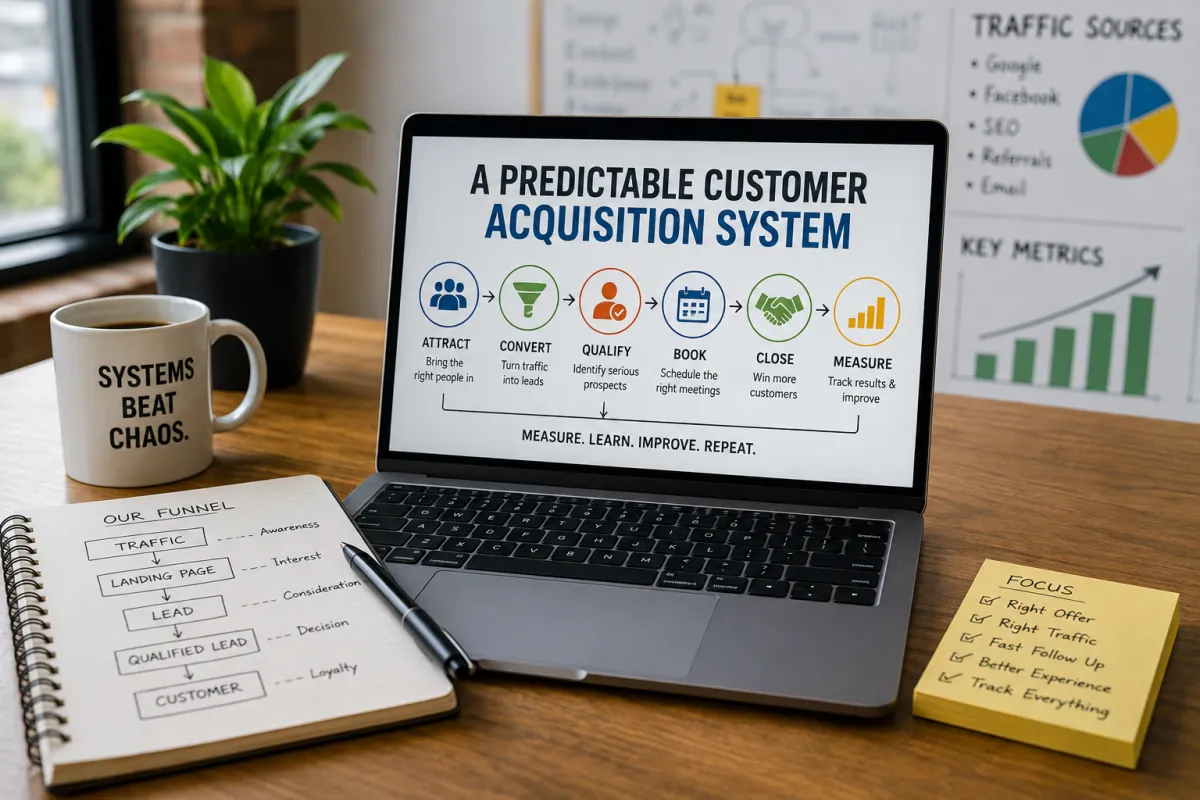
How to Build a Predictable Customer Acquisition System
A predictable customer acquisition system connects a defined target customer, compelling offer, reliable traffic sources, conversion-focused landing experience, fast lead follow-up, structured sales process, and accurate performance tracking. Predictability comes from measuring conversion rates at each stage and improving the weakest point instead of simply spending more on marketing.
Predictable Growth Starts With a System, Not More Leads
Monday is busy.
Five new inquiries come in before lunch.
Tuesday brings another three.
Wednesday?
Nothing.
Thursday?
One lead that never answers the phone.
Then Friday afternoon arrives and someone asks the question every business owner eventually asks:
"Where are next week's customers coming from?"
If the answer is "hopefully Facebook," "maybe referrals," or "we'll increase the Google Ads budget," you do not really have a customer acquisition system yet.
You have marketing activities.
There is a difference.
A predictable customer acquisition system creates a repeatable path that moves the right people from stranger to prospect to qualified lead to customer.
It will never make revenue perfectly predictable. Customers are human, markets change, competitors react, and no advertising channel performs identically forever.
But it can make growth considerably less dependent on luck.
Here is how to build one.
1. Start With the Customer, Not the Marketing Channel
A common mistake is beginning with:
"We need Facebook Ads."
Why?
Who are you trying to reach?
What problem are they experiencing?
Why would they choose you?
Until those questions are answered, selecting a channel is premature.
Start by defining your best customer.
Not everyone who could technically buy.
Your best customer.
Consider:
What problem brings them to you?
How urgent is that problem?
What does solving it mean financially or emotionally?
What usually prevents them from buying?
What questions do they ask before deciding?
Where do they look for solutions?
For a foundation contractor, the customer may be a homeowner who discovers a horizontal basement crack after several days of heavy rain.
For an accountant, it might be a business owner frustrated by messy books and unexpected tax bills.
Those customers behave differently.
Your acquisition system should reflect that.
2. Turn Your Service Into an Offer
Your service and your offer are not the same thing.
Service: Foundation repair.
Offer: Schedule a foundation inspection and find out what is causing the cracks before deciding on a repair.
Service: Digital marketing.
Offer: Get a marketing assessment showing where leads are being lost and which opportunities deserve attention first.
The service describes what you sell.
The offer gives someone a reason to take the next step.
A strong offer answers:
What do I get?
Why should I care?
Why should I act now?
What happens next?
This is often where customer acquisition improves before an additional dollar is spent on advertising.
3. Choose Traffic Sources Based on Intent
Not all traffic behaves the same way.
Someone searching Google for:
"emergency foundation repair near me"
has a very different intent from someone casually watching a home renovation video on Facebook.
Both people may eventually become customers.
They are simply at different stages.
Your acquisition strategy might include:
Search
Google Ads and SEO can capture existing demand from people actively looking for a solution.
Social Advertising
Facebook, Instagram, LinkedIn, or other platforms can help generate demand, retarget prospects, and introduce offers to relevant audiences.
Organic Content
Useful articles, videos, guides, and local content can create visibility before someone is ready to buy.
Referrals
Past customers and professional partners can produce highly valuable prospects.
Email and CRM
Existing leads should not disappear simply because they did not purchase immediately.
The objective is not to be everywhere.
It is to identify a manageable group of channels that consistently put your offer in front of the right people.
4. Give Every Campaign One Clear Destination
Here is a surprisingly common acquisition journey:
Ad → Homepage → Confusion → Exit
The advertisement talks about one specific problem.
The homepage talks about 14 different services.
The visitor has to figure out where to go next.
Most will not.
Instead, maintain continuity.
If the ad says:
"Stop Basement Water Before the Next Storm"
the landing page should immediately continue that conversation.
Not:
"Welcome to ABC Construction, Your Trusted Partner Since 1987."
The visitor should instantly understand:
They are in the right place
You understand the problem
You provide the solution
There is a clear next step
A strong conversion-focused website strategy should make moving forward easier than leaving.
5. Remove Friction From the Conversion
Imagine someone is ready to contact you.
Then you present a form asking for:
First name
Last name
Phone
Email
Full address
City
State
ZIP code
Budget
Timeline
Preferred appointment
Detailed description
How they heard about you
Suddenly, "Get a Quote" feels like applying for a mortgage.
Collect what you genuinely need to begin the conversation.
Additional qualification can happen later when appropriate.
Also test the experience on a phone.
Can someone:
Understand the page quickly?
Tap the phone number?
Complete the form comfortably?
Find the CTA without searching?
Load the page quickly?
Google's Core Web Vitals guidance explains how loading performance, responsiveness, and visual stability contribute to page experience.
A great campaign should not send expensive traffic into a frustrating website.
6. Treat the First Five Minutes After a Lead Differently
The form submission is not the finish line.
It is the handoff.
A lead submits:
"My basement wall is cracking. Can someone look at it?"
Then wait.
And wait.
Meanwhile, they continue searching.
Your competitor answers first.
Customer acquisition therefore includes what happens after acquisition.
Build a follow-up process that can include:
Immediate confirmation
Internal notification
Fast phone outreach
Text follow-up where appropriate
Email follow-up
Additional attempts if the prospect cannot initially be reached
The exact process depends on your business, but leads should never sit unnoticed in an inbox.
7. Build a Real Pipeline
A spreadsheet containing 300 names is not necessarily a sales pipeline.
A useful pipeline tells you where every opportunity currently stands.
For example:
New Lead → Contacted → Qualified → Appointment Booked → Proposal Sent → Won/Lost
Now you can answer useful questions.
How many leads become appointments?
How many appointments receive proposals?
How many proposals become customers?
Where are opportunities disappearing?
Without stages, marketing and sales become a giant bucket of leads.
With stages, you can see the leaks.
8. Track the Entire Journey, Not Just the Lead
This is where predictable acquisition starts becoming mathematical.
Suppose you spend $5,000 on advertising.
You generate:
100 leads
Your cost per lead is:
$50
That sounds useful.
But now follow those leads.
Out of 100:
70 are contacted
40 are qualified
30 book appointments
24 show up
15 receive proposals
6 become customers
Suddenly, the most important number is not $50.
It is:
$833 customer acquisition cost
Now suppose the average new customer produces $5,000 in gross profit.
You have information you can actually use to make decisions.
Google Analytics provides tools for measuring events and conversions across digital experiences, while advertising platforms and CRMs can add additional visibility into the journey.
The closer your tracking gets to actual revenue, the more useful your marketing data becomes.
9. Find the Bottleneck Before Increasing the Budget
This is one of the most valuable habits in marketing.
Suppose you want more customers.
The immediate reaction is:
"Spend more."
But consider this funnel:
1,000 visitors
100 leads
50 qualified leads
20 appointments
5 customers
Where should you invest?
Maybe traffic is not the problem.
Perhaps the landing page converts well, but 50% of qualified leads never book.
Fixing appointment booking could generate more customers from the same advertising spend.
Look for the weakest conversion point.
That might be:
Ad click-through rate
Landing page conversion
Lead qualification
Contact rate
Appointment booking
Show rate
Proposal close rate
Growth often comes from repairing the leak rather than pouring more water into the bucket.
10. Know Your Numbers
You do not need a 50-tab analytics dashboard.
Start with a few useful metrics.
Cost Per Lead
Advertising spend ÷ leads generated.
Qualified Lead Rate
Qualified leads ÷ total leads.
Appointment Rate
Appointments booked ÷ qualified leads.
Close Rate
Customers ÷ qualified opportunities.
Customer Acquisition Cost
Total acquisition spend ÷ new customers.
Customer Value
How much gross profit or contribution does a typical customer create?
Once you know these numbers, you can model growth.
What Predictability Actually Looks Like
Suppose your historical data shows:
Average customer acquisition cost: $600
Average gross profit per customer: $3,000
Typical monthly acquisition budget: $12,000
You might reasonably forecast around 20 customers if performance remains consistent.
Will it be exactly 20?
Probably not.
One month might produce 17.
Another could produce 24.
Predictability does not mean certainty.
It means you have enough historical evidence to make reasonable business decisions instead of guessing.
11. Build Follow-Up for People Who Are Not Ready Yet
Not every good lead buys immediately.
Some customers need:
Another conversation
Approval from a spouse
Financing
Budget planning
More information
Better timing
If your system treats "not today" as "never," you are wasting opportunities you already paid to create.
Use your CRM to maintain appropriate follow-up.
That could include:
Educational emails
Project examples
Testimonials
Seasonal reminders
Useful guides
Personal check-ins
The objective is not to annoy people until they surrender.
It is to remain useful and memorable until their timing changes.
12. Feed Sales Outcomes Back Into Marketing
This is where many acquisition systems break.
Marketing knows:
We generated 80 leads.
Sales knows:
Most of them were terrible.
Neither side connects the data.
Marketing should know which campaigns generated:
Qualified leads
Appointments
Proposals
Customers
Revenue
A campaign generating $25 leads may look incredible until you discover none of them buy.
Another campaign generating $90 leads may look expensive until you discover those prospects close at three times the rate.
The cheapest lead is not always the best lead.
Optimize toward customers, not form submissions.
13. Create a Testing Rhythm
Predictability does not mean running the same campaign forever.
Eventually, performance changes.
Instead, build testing into the system.
Test one meaningful variable at a time:
Month 1: Offer
Month 2: Creative
Month 3: Landing page headline
Month 4: Follow-up sequence
Record what happened.
Over time, you stop relying purely on marketing opinions.
You develop your own evidence about what your customers respond to.
14. Document What Works
This is the final step many businesses skip.
When something works, write it down.
Document:
Target customer
Offers
Campaign structure
Landing pages
Lead qualification criteria
Follow-up process
Sales stages
Reporting metrics
Testing process
Why?
Because a system that exists only inside one employee's head is not really a system.
Documented processes are easier to repeat, train, evaluate, and improve.
The Customer Acquisition Equation
You can simplify the entire system into this:
Traffic × Conversion Rate × Qualification Rate × Close Rate = Customers
For example:
2,000 monthly visitors
× 5% conversion rate
= 100 leads
× 60% qualification rate
= 60 qualified leads
× 25% close rate
= 15 customers
Now look at what happens if you improve the landing page conversion rate from 5% to 7%.
2,000 visitors
× 7%
= 140 leads
× 60%
= 84 qualified leads
× 25%
= 21 customers
You did not increase traffic.
You improved one part of the system.
That is why conversion optimization can be so powerful.
Frequently Asked Questions
What is a customer acquisition system?
A customer acquisition system is a repeatable process for attracting prospects, converting them into leads, qualifying and following up with those leads, closing customers, and measuring performance across the entire journey.
How do you make lead generation predictable?
Track historical conversion rates throughout your funnel. Once you understand the relationship between traffic, leads, qualified opportunities, appointments, and customers, you can make more realistic forecasts and identify where improvement is needed.
What is a good customer acquisition cost?
There is no universal good CAC. An acceptable acquisition cost depends on customer lifetime value, gross margin, repeat business, overhead, and other financial factors specific to the company.
Should small businesses use multiple marketing channels?
Usually, but that does not mean using every available platform. A small number of reliable channels can be easier to measure and optimize than spreading a limited budget across too many platforms.
Why do I get leads but not enough customers?
The problem may occur after lead generation. Slow response times, weak qualification, poor appointment booking, inadequate follow-up, pricing, sales processes, or low-quality traffic can all reduce the percentage of leads that become customers.
Stop Asking, "How Do We Get More Leads?"
There is a better question:
"How do we get more of the right people all the way to becoming customers?"
That changes everything.
You stop celebrating cheap leads that never answer.
You stop increasing ad budgets before checking the sales process.
You stop treating marketing, websites, CRM, follow-up, and sales as separate activities.
Instead, they become parts of one system:
Attract → Convert → Qualify → Follow Up → Sell → Measure → Improve
That is what creates predictability.
Not a secret Facebook targeting trick.
Not one perfect Google Ads campaign.
Not publishing 50 blogs and hoping traffic arrives.
A system.
If your business generates traffic and leads but struggles to turn that activity into consistent customer growth, Top Choice Marketers can help connect the pieces, from lead generation and conversion strategy to tracking and campaign optimization.
Because the goal of marketing should not be to keep you busy wondering where the next customer will come from.
It should help you build a process capable of producing the next one again and again.
