Foundation Repair Marketing: Why Cheap Leads Cost More
Most foundation repair companies judge their marketing success by one number: cost per lead.
It's the easiest metric to see in Google Ads, Meta Ads, or your CRM, so it's often the one business owners obsess over.
Unfortunately, it's also one of the most misleading numbers in foundation repair marketing.
A campaign can generate inexpensive leads all month long while still losing money because those leads never become inspections, estimates, or completed jobs.
If you're only tracking cost per lead, you're only measuring the first step of your customer's journey, not whether your advertising is actually producing revenue.
The Metric Most Foundation Repair Companies Optimize Is the Wrong One
Here's what happens inside many foundation repair advertising campaigns.
The campaign launches.
Leads start coming in.
The cost per lead looks great.
Everyone is happy.
Then a few weeks later, the cost per lead increases slightly.
Immediately, someone assumes:
Google Ads stopped working.
The market became more competitive.
The agency needs to change everything.
But the campaign may still be profitable.
Why?
Because cost per booked inspection matters far more than cost per lead.
An £20 lead that never answers the phone is actually more expensive than a £70 lead that schedules an inspection and turns into a £9,000 foundation repair project.
That's why successful contractor marketing focuses on revenue and not lead volume.
Why This Happens So Often in Foundation Repair Marketing
Unlike emergency home services such as HVAC or plumbing, foundation repair has a unique buying journey.
A homeowner notices:
wall cracks
uneven floors
sticking doors
basement water intrusion
They become concerned.
They search Google.
They request a quote.
Then...
Nothing.
Life gets busy.
The urgency fades.
They ignore your phone calls.
The lead that looked promising yesterday becomes impossible to reach a few days later.
That's why speed-to-lead and follow-up systems often determine whether your advertising succeeds, not the ad itself.
Foundation Repair Has a Longer Sales Cycle
This industry behaves differently from many other local service businesses.
Someone with no air conditioning in July needs help immediately.
Someone with a cracked basement wall may wait weeks before making a decision.
That means your sales process must bridge the gap between:
Ad Click → Lead → Phone Conversation → Inspection → Proposal → Job
Every missed follow-up increases your real acquisition cost.
Many contractors mistakenly blame Google Ads when the real issue is inconsistent follow-up.
Seasonality Changes Lead Quality
Foundation repair and waterproofing also experience strong seasonal trends.
For example:
Heavy rainfall often increases waterproofing enquiries.
Long dry summers create more foundation settlement concerns.
Freeze-thaw cycles can expose structural movement.
If your advertising budget stays the same year-round, your conversion rates probably won't.
A higher cost per lead during peak buying months can still produce a much lower cost per completed job.
Without tracking the entire sales funnel, it's easy to assume the advertising became less effective when customer urgency simply changed.
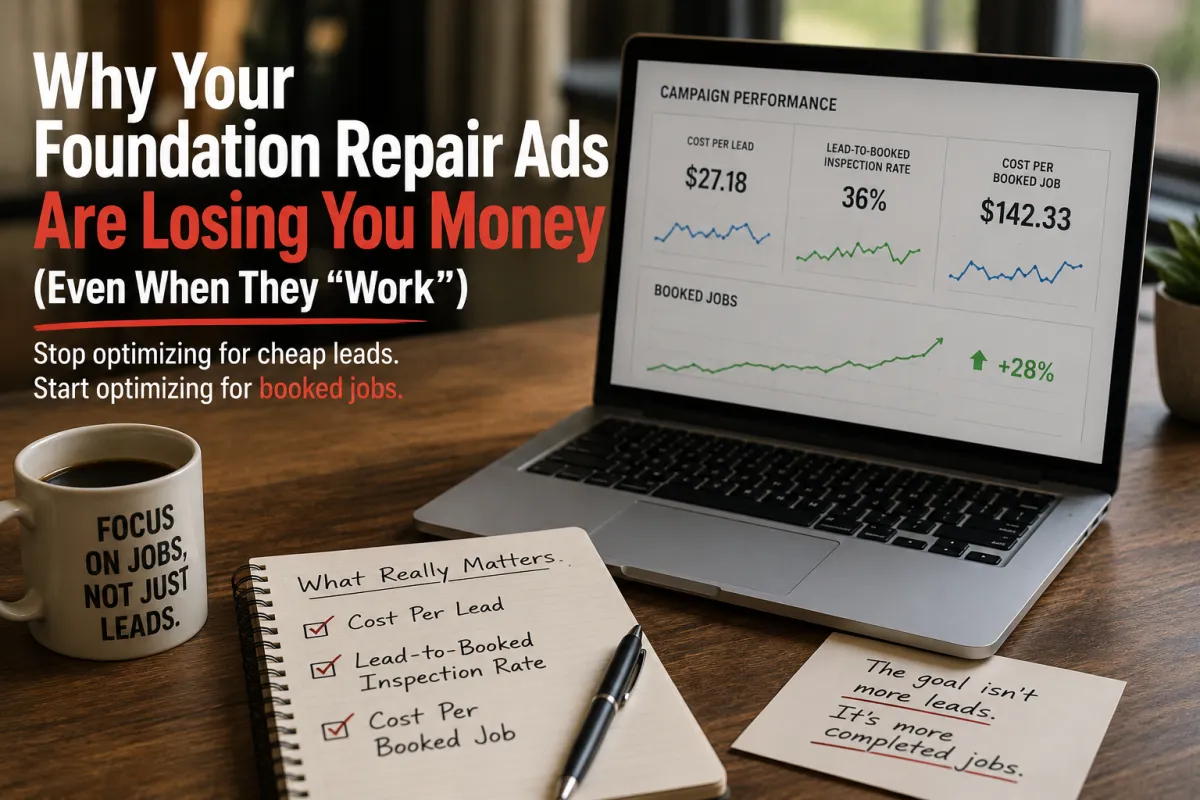
The Three Numbers Every Foundation Repair Company Should Track
Instead of focusing on one marketing metric, track these three:
1. Cost Per Lead
This tells you how efficiently your ads generate enquiries.
It's useful, but only as an early indicator.
Never use it as your primary success metric.
2. Lead-to-Booked Inspection Rate
This is often where contractor marketing campaigns succeed or fail.
If your booked inspection rate is below 30%, your biggest opportunity probably isn't your advertising.
It's your follow-up process.
Improving:
response time
phone scripts
text reminders
email follow-ups
CRM automation
can dramatically increase booked appointments without increasing ad spend.
3. Cost Per Booked Job
This is the number that actually matters.
It tells you how much marketing investment is required to produce paying customers.
Everything else supports this metric.
The Follow-Up Gap That Costs Contractors Thousands
Many agencies proudly report:
140 leads generated
£28 cost per lead
5% click-through rate
Those numbers look impressive.
But if only 18 homeowners schedule inspections, the campaign's performance looks very different.
The biggest leak in most foundation repair marketing funnels isn't Google Ads.
It's the gap between the lead form and the first conversation.
Improving that gap often produces larger revenue gains than increasing the advertising budget.
The Marketing Conversation Most Agencies Never Have
Here's where many contractor-agency relationships become frustrating.
The agency reports the numbers it can easily measure.
The contractor wants more booked jobs.
Neither side measures what happens in the middle.
Without connecting:
CRM data
call tracking
booked inspections
completed projects
it's impossible to understand true marketing ROI.
That's why businesses that integrate their CRM with their advertising platform often make better budgeting decisions than those relying on cost per lead alone.
How to Measure the Real Return on Your Advertising
Ask yourself these questions:
How many leads became inspections?
How many inspections became paying customers?
What was the average project value?
What did it cost to acquire one completed job?
Which campaign produced the highest revenue—not just the most leads?
These answers provide a much clearer picture of advertising performance than cost per lead ever will.
The Bottom Line
Cheap leads aren't always profitable leads.
The most successful foundation repair companies don't optimize their advertising for the lowest cost per lead.
They optimize for booked inspections, completed projects, and long-term return on investment.
If you start measuring the full customer journey, from the first ad click to the final signed contract, you'll stop making marketing decisions based on vanity metrics and start investing in campaigns that actually grow your business.
Frequently Asked Questions
Why are my foundation repair ads generating leads but not booked jobs?
Generating leads is only the first step. Many foundation repair companies lose potential customers because of slow response times, inconsistent follow-up, or a lack of lead nurturing. Improving your speed-to-lead, call process, and follow-up system can significantly increase the number of booked inspections without increasing your advertising budget.
What is more important than cost per lead in foundation repair marketing?
While cost per lead is a useful metric, cost per booked job provides a much clearer picture of your marketing performance. A lower-cost lead that never schedules an inspection is ultimately more expensive than a higher-cost lead that becomes a paying customer. Tracking the entire customer journey helps you measure your true return on investment.
How can foundation repair companies improve the quality of their leads?
Improving lead quality starts with targeting the right audience and matching your ads to high-intent search terms. Equally important is having a well-optimized landing page, a fast response process, and a structured follow-up system. Together, these elements help convert more enquiries into booked inspections and completed projects.
Should I optimize my Google Ads campaign for leads or booked inspections?
The best-performing foundation repair companies optimize beyond simple lead generation. While generating enquiries is important, your ultimate goal should be increasing booked inspections and completed jobs. Tracking conversions throughout your sales process allows you to identify which campaigns produce the highest revenue, not just the most leads.
How do I know if my foundation repair advertising is actually profitable?
The most reliable way to measure profitability is by tracking key performance indicators across your entire sales funnel. Monitor your cost per lead, lead-to-booked inspection rate, cost per booked job, and the revenue generated from completed projects. This data helps you make informed marketing decisions and invest more confidently in campaigns that deliver real business growth.
